Every parent dreams of his child, except for the native language, to learn with ease and at least one foreign person. This is quite understandable because of the advantages that learning different languages provides in the dynamically developing world.
There are many opportunities for this dream to be realized both for children and adults. One of the best solutions is to get acquainted with different language courses in the Language School Omega and choose a convenient form of language training for you.
When it comes to learning a foreign language, the question of the right one age He's always been a bit of a brawler, but as far as the idea of binguism in childrenThe sooner the preparations begin, the better.
The ability to learn foreign languages in children
According to educators (if the child does not live in a family of mixed marriage, where he has mastered both languages at the same time as his birth), the most appropriate age for starting linguistic training is between 3 and 4. Then the child had already learned and laid the foundations for speech and pronunciation and preparation was easy to play and sound. With some grammatical rules, children can only get acquainted after the age of 6.
There are experts who believe that the training should start after 7 years of age when the child has learned a more complex share of his native language. There is also a compromise approach, according to which the optimal time for introducing a foreign language is between 5 and 7 years.
In any case, a number of subjective factors including individual rates of childhood development should be taken into account, what the objectives of the course will be, the personal interest of the young student and the parental preferences. All researchers agree that each learning at different ages with a qualified teacher gives results, but is most effective and easy before puberty occurs.
It's been proven to be what we call a "big deal." high school a brain part is activated that connects to the rational, not to the auditory learning mechanism . ? Children under 5-7 years of age are not afraid of mistakes and can easily master the subconscious language. They also have a very good memory because of the upsurges Brain growth and languages of each type learn significantly easier.
The advantages of early language learning
The perception that if children are introduced to a foreign language early on, it will prevent spelling and the speech of mother tongue from being considered obsolete for a long time. The truth is that many modern studies confirm the benefits of Early language learning. According to experts, children's linguistics, studying the language perception of children, Language training by foreign language they shall be increased:
- the memory and concentration;
- the ability to perform several tasks simultaneously;
- creativity and more flexible Cognitive development and others.
Thanks to early introduction to foreign language structures, the level of Language absorption may reach this in the mother tongue, especially when properly used Educational strategies.
How does age affect methods?
In their common part, the methods applied to master a foreign language by both children and adults are similar because they rely primarily on communication and visualization. At the same time, however, age also determines some key differences.
In order to demonstrate the benefits of early foreign language training, it must be conducted by teachers with special training. Investigations psychology of training show that the natural transition from unconscious perception in children to conscious learning at a later stage will be smooth and stressful only if it is done with appropriate methods.
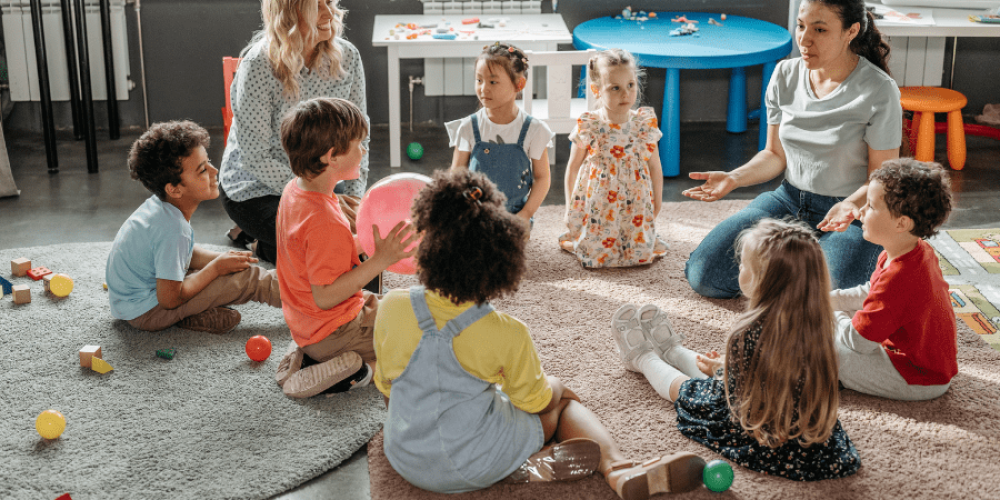
The most important course is to awaken positive emotions and desire to participate according to the temperament of the child. The game form is best suited at preschool age because, having fun, children learn. For this purpose, the most common use is:
- songs and poems for developing auditory memory;
- Talking with images and educational films with few dialogues and clear actions of characters, helping to memorize words in the context of a given situation.
Since in his first years, the child does not realize that it is a foreign language, he does not encounter a language barrier .
Audio and video materials used in kindergartens are also an option, and communication with peers in the form of a game is suitable for the development of psychic and social skills at an early age.
The presence of increased concentration and desire for systemic knowledge in the child is an undeniable sign that parents can enroll it in a language school. There the teachers take into account the individual characteristics of each young student, age and pace of progress.
Comparison between language training in children and adults
Although it is widely believed that children learn foreign languages more easily than adults, the claim is not entirely true. The purely biological features of children's development and their innate curiosity allow for an extremely fast pace of learning, but this does not mean that it cannot be reached at a later stage.
First of all, the adult brain is fully developed. Their experience helps them to think logically and make associations, while children need much more repetitions of a particular material to master it.
If children are more easily attracted to the sounds of foreign language, they give the older ones complex structures and more abstract concepts because they already know these categories and they know how to learn.
A great advantage in adults is the high level of self-control, motivation and discipline . Naturally, over the years, the vocabulary is enriched, knowledge of the device of the language is accumulated, to which it can easily adapt new grammatical rules.
In addition, older people are able to have greater flexibility in learning ways. Information source can be language courses, books and films in foreign language, travel abroad, communication and self-teachers through mobile applications, online resources and lessons.
Language School You can save your child in individual or group activities, and if you need to raise level or train for full beginners, explore the great opportunities of Omegals.bg.