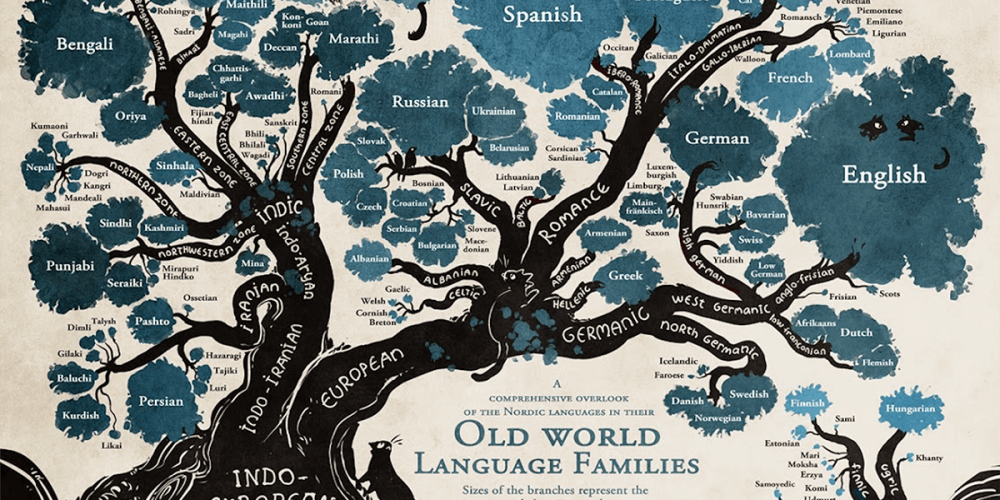
As expressive as our gestures and mimics may be, they cannot exhaust the wealth of our thought . . . . . that is also the reason for the emergence of speech as a universal means of communication between residents in one territory. Today, each of the human languages can be summarized in this way . . a system of sound with strict rules that help us express thoughts and exchange information with others. We will try to shed some light back in history and trace the connections between one of the most common Gospels.
Total root
English philologist William Jones is the first to express the thesis that European languages have a common root. Their ancestor is called Indo-European, so they belong to the Indo-European family today. It is divided into different groups, which unite close by structure languages, for example: Balto-Slavian . . part of them are Bulgarian, Russian; . . . . . . today's German and English, and Italian . . . where is Latin and its successors . . . . . . . . . . . . . . . . . . . . . . . . . . . . . . . . . . . . . . . . . . . . . . . . . . . . . . . . . . . . . . . . . . . . . . . . . . . . . . . . . . . . . . . . . . . . . . . . . . . . . . . . . . . . . . . . . . Evidence in favour of common origin is sufficient, but we will not bore you with boring philological information. Here is a curious example:
English
1. lie (lay, lain) < lien, liggen < licgan < *ligjaną < *legh; 2.lie (lied, lied) < lien < lēogan < *leuganą < *lewgh; 3. lay (laid, laid) < layen, leggen < lecgan < *lagjaną < *ligjaną, *legjaną< *legh.
German
1. liegen (lag, gelegen) < liggen < *ligjaną < *legh; 2. lügen (log, gelogen) < liogan < *leuganą < *lewgh; 3. legen (legte, gelegt) < leggen < *lagjaną < *ligjaną, *legjaną< *legh.
Bulgarian
1. lie (lost, lying) < laid < *ležati < *legh; 2. lie (lid, lied) < liars < *lugati < *lug-< *lugh; 3. I'm gonna lay down.
Where are they talking today?
The Indo-European Pre-language's homeland is believed to be the territories of north-northwest of the Black Sea and Armenia. Today, however, his heirs have spread throughout the world. Let's take a look at one of the most famous:
- English
Part of the West German group. According to official data, today he was born for over 300 million people worldwide. As a second, he is ruled by over a billion people, which gives him the right to call himself a universal mediator in communication between the inhabitants of the planet. Probably to his popularity contributes mainly his relatively easy grammar, which in no way influences his wealth by expressive means.
- German
The official is in Germany, Austria, the majority of Switzerland, Liechtenstein, Luxembourg and Belgium. They also speak it in South Tyrol in Italy, the Eastern Cantons of Belgium and southern Denmark, parts of Romania, in Alsace and northeast of Upper Lotharingia in France. German-speaking communities are present in different European countries, the United States, as well as in some Latin American like Argentina and Brazil.
- French
It's the mother of over 100 million people, and for almost 300 million it's second. In addition to France, it is also official in Belgium, Luxembourg, Switzerland, Monaco, Canada, Andorra, Mali, Mauritania, Guinea. The main difficulty with him comes from the fact that his spelling is significantly different from pronunciation.
- Spanish
It's the most common Romance language. It is the third most spoken in the world . . . of about 550 million people. And although it originated in Spain, the most Spanish speakers today are in Latin America. The white-headed bat ("Apocas typus") is a species of rodent in the family Cricetidae. An interesting detail is that the Spanish themselves call their language Castile. This is necessary because there are several more locals in the country . . . . . . . . . . . . . . . . . . . . . . . . . . . . . . . . . . . . . . . . . . . . . . . . . . . . . . . . . . . . . . . . . . . . . . . . . . . . . . . . . . . . . . . . . . . . . . . . . . . . . . and Catalan.
- Italian
Besides Italy, it is also spoken in southern Switzerland, on the Croatian peninsula Istria, Somalia and anywhere where there are large Italian communities around the world. However, it is characteristic of Italy that each of its regions has its own dialect close to the literary speech.
- Russian
The most popular Slavic language in the world, spoken by about 260 million people. He is an official in Russia, Kazakhstan, Belarus, Kyrgyzstan and Tajikistan. In many other countries in the region, and around the world, it was born to a significant part of the population. It is a curious fact that by the end of 17th century official in the country was the old Bulgarian in its Russian version.
Why do we have to learn foreign languages?
The shortest answer is . . so that you can get along with people from different countries and nationalities. However, each language also expresses a specific model of thinking, world and life perspective that its carriers share. So, learning a new one, you will not only be able to communicate freely with more people, but you will also expand your own perception of your surroundings. Remember also that learning a new foreign language contributes to creating new connections in the brain. That is, this will help you think creatively and flexiblely as never before, more and more.
So do not hesitate, but take a course at the Language School . More about our courses you can learn from https://omegals.bg/kursove/ Or by calling us personally on 02/423 21 21; 0878 566 537.