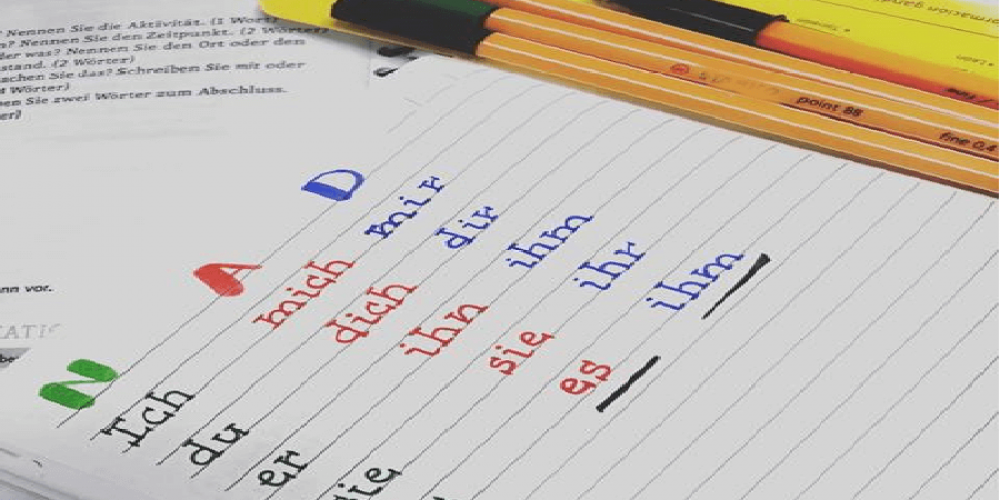
Many people fear going to German because of the maturity in it. However, like any other part of grammar, they have their logic. Even if you have never spoken a language that deals with a mature system, you should not despair even before you have tried. So we decided today to introduce you to the Germans' maturity and to dispel your doubts that learning them is impossible.
Nominativ
This is the easiest maturity because its shape is the basic /dictionary/ form of all the names parts of speech - noun, adjective, pronoun, numerative. They also call him Werfall because he answers the questions who? (wer?) for the lively and what? (was?) for inanimate objects. The main use of Nominativ is in names that are subject to speech, meaning they perform the action. For example:
Die Ärztin kommt später. It can also be used as an annex to the subject - Moscau,
die russische Hauptstadt, ist eine der schönsten Städte der Welt. It is important to note that there are verbs that require its use along with the alliances wie, als. These are aussehen (seem), sich ausgeben als (I am posing for), sich benehmen wie (retented as), dien (D) als (service as), sich erweisen als (prove me), gelten als (come to, I consider myself to be), sich zeigen als (becoming like) and some others.
Vinous maturity (Akkusativ)
Answers the questions wen? (who) for the lively and was? (What?) for inanimate objects. There's another question with him - wohin? (n) where?), in these cases the noun that is in a wine maturity is in the role of circumstance in the sentence. So, from a syntactic point of view, this is the direct addition. One of the most important things about Akkusativ that there are two types of verbs used with it. The so-called single-valent ones require only and only a guilty maturity. However, two-valent ones - that is, those who have two objects - require a guilty and parental or a guilty and tax-bearing one. The first group included: lesen (readings), trinken (drink), essen (yam), bauen (building), angehen (cast, I have a relationship), Kennen (know), lieben (love) and many others. To avoid making mistakes, however, you need to learn what are the two-valent verbs. You will easily find out when to use Akkusativ if you learn the prepositions that require it: bis (to), Durch (through, through), für (for), gegen (against, around), ohne (without), pro (c), um (around), entlang (over), wider (against, despite).
Parental maturity (Genitiv)
It's used to express possession. Its most common use is in the construction noun + noun: die Kleider des Kindes (the child's clothing). Such nouns answer the question of whose? (wessen?). Just remember that the second noun is always at parental maturity. When we talk about Genitiv, we should pay attention to the formation of male and middle-generation forms: they usually get endings .
meines Vaters.
Total amount of the debt instruments issued (Dativ)
This is the indirect addition and answers wem questions? (whom?), woh? (Where?) wan? (when?). This site shall participate in the action as its addressee: “Ich habe meiner Frau einen Ring gegeben. - I gave my wife a ring. Dativ is also used after certain alliances. These are for example: aus (ex, from), bei (in, c), entgegen (on the contrary, despite), gegenüber (on, relative to, mit (with), nach (in, to), seet (from), von (from), zu (to, on, c). When it comes to maturity, one of the most important things is to remember how the definite and undefined article changes to them. Here are two short tables that will help you:
| Concluding to the Undetermined Member |
|
Males |
Female seed |
Medium seed |
Mn. h. |
| Nominative |
ein |
eine |
ein |
-eine |
| Acusative |
einen |
eine |
ein |
-eine |
| Date |
einem |
einer |
einem |
-einen |
| Genitive |
eines |
einer |
eines |
-einer |
| The designation of the member |
|
Males |
Female seed |
Medium seed |
Mn. h. |
| Nominative |
der |
die |
das |
die |
| Acusative |
den |
die |
das |
die |
| Date |
dem |
der |
dem |
den |
| Genitive |
des |
der |
des |
der |
But remember, all this is just a brief review of the maturity system in German.
More about our German courses can be seen here . . https://omegals.bg/kursove/za-vyzrastni/nemski-ezik/
If you want to learn how to write and speak freely in German . . contact us . . Tel: 02/423 21 21; mob: 0878 566 537; email: office@omegals.bg