- It is official in four European countries - Germany, Austria, Switzerland and Luxembourg;
- it is spoken in South Tyrol in Italy, the Eastern Cantons of Belgium and southern Denmark, parts of Romania, in Alsace and northeast of Upper Lotharingia in France, as well as in many former German colonies around the world;
- BMW, Metro, Bosch, Henkel … are just a small part of the world-famous German corporations, and you'll need the language if you want to build a career there.
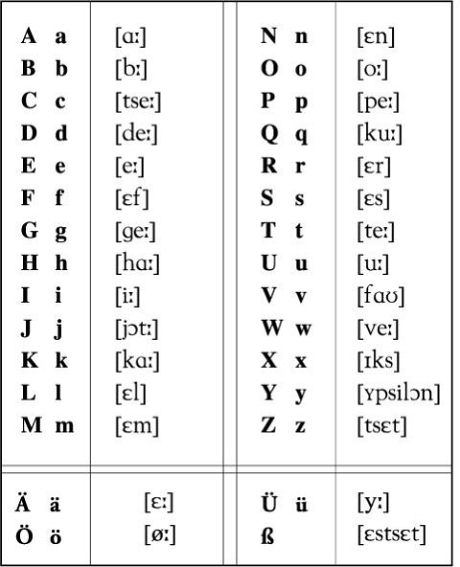
German alphabet
If you already know English or any other language that uses Latin alphabet, then it takes a little effort to learn some of the specifics here:- Of a thickness exceeding 0,5 mm
Ä ä - read as [
Ö ö - read as [ø
Ü ü - read as [y "]2. Escet
Write "ß" and read as double
And here are the other letters and their transcribed pronunciation.
The numbers in German
And here, the numbers are divided into simple, complex and derivative. But like most things about the Germans, iron rules are in place here. You just need a little effort to learn how to count to... Well, as long as you want! Simple - or these are those numbers that are named by a certain word:- zero - zero
- eins - one
- zwei - two
- drei - three
- vier - 4
- fünf - five
- sechs - Six
- sieben - 7
- acht - 8
- neun - Nine.
- zehn - 10
- elf - 11.
- zwölf - 12
- einhundert - 100
- eintausend - A thousand.
- vierzehn Fourteen.
- fünfzehn 15
- sechzehn 16
- siebzehn seventeen.
- achtzehn 18
- neunzehn Nineteen.
- zwanzig - 20
- dreißig - 30
- vierzig - 40
- fünfzig - 50
- Sechzig - 60
- siebzig - 70
- achtzig - 80
- neunzig - 90
- einundzwanzig - Twenty-one.
- zweiundzwanzig - Twenty-two.
- dreiundzwanzig - Twenty-three.
Grammar
Well, here you should already make more effort, though, grammar is the backbone of any language. But don't be in such a hurry to discourage yourselves! Before you start learning the language, make sure that your motivation is good and you can take the time to learn. And we're going to help you a little bit more with some notes on basic grammatical rules. so you will be sure that you will start your training without the delusions of type -- Incorrect verbs
- bleiben-blieb-geblieben
- leiden-litt-gelitten
- bieten-bot-geboten
- Name of the company (Nomsnat ve) - the main form of property, capacity, location and politic.
- A vintage unit (Akkusat yat ev) - answer the questions wen? (sighs) for the strangled and the woofy? For the last few months. You will be able to find the right answer to this question.
- A traditional unit - used for the protection of a property. The most important thing is the very first thing in his life. Those are the victims of who's question? (we're not?). Just remember that the second and last time is always in a traditional custody.
- Yes, I'm afraid so. What? (sighs) wann? (now?).
- Präsens - Transmits actions occurring in the present or those regularly repeated, common phenomena. Just verb time, t. e. formed without the participation of auxiliary verbs. When the verbs are stopped, the endings are added to the verb base.
- Präteritum - Also simple - formed without the participation of auxiliary verbs. In it begins the division of German verbs of strong and weak. He uses oral and written accounts, narratives, literary works.
- Perfekt - It is formed by the personal form of one of the auxiliary sein or haben and Partzip II forms of the basic verb. It is mainly used in conversation, talks, conversations when it is necessary to transmit an action that precedes another action.
- Plusquamperfekt - A complex time form in which the selected adjutant verb is tightened into Präteritum. It is used for expressing an action that takes place in the past and is preceded by the basic.
- Futurum I - He only uses it to convey future time, meaning that it is identical with Präsens for expressing actions in the future. Its use is characteristic of the literary language, unlike Präsens, which is used in the conversational speech. It is formed by the auxiliary verb werden, which is structured in the respective personal form in Präsens, the basic (similation) verb in Infinitiv I.
- Futurum II - Forms with the auxiliary werden in the respective personal form and Infinitiv II of the basic verb. It is not used in oral speech, and it is very rare in written speech only to stress that one of the future actions precedes the other. Futurum II transmits the alleged action in which the speaker is sufficiently confident.