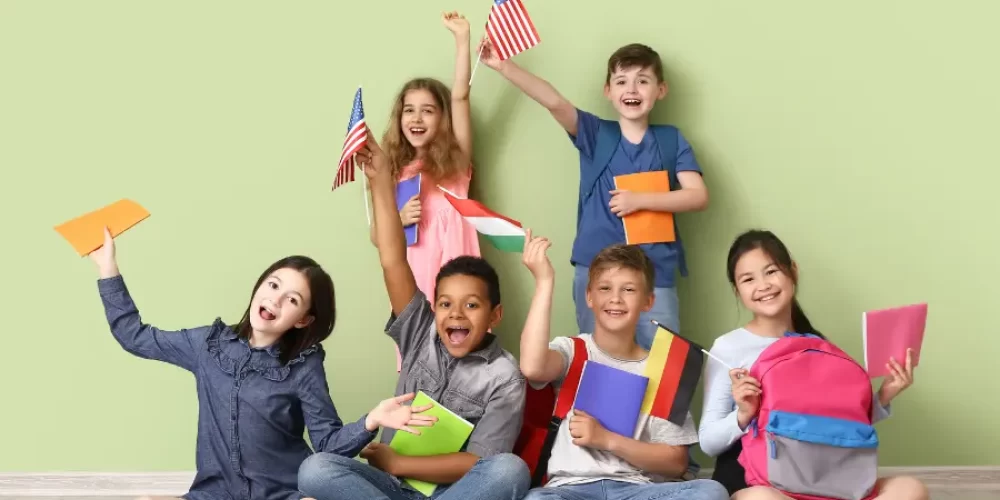
The knowledge of one or more foreign languages is an extremely highly valued skill worldwide because of the great development opportunities it provides. This is also why parents seek effective ways of teaching their children foreign language, complementary to the school or kindergarten language classes.
Experts advise that the child's systematic learning of a new language should start after first grade, since by then it has already acquired an idea of what the structure of the native language is. After 7 years of age, children are not at issue to learn more than one foreign language according to their individual characteristics.
Practice shows that when it comes to language training of childrenIt is important to engage their attention. This will help not only to enjoy the rules of language, but also to use it with ease.
Along with the classic method based on translation and absorption of grammatical rules, use of innovative methods leads to a bigger engaging students to include them in activities relating to the practical side of learning the relevant language.
Adapting training methods to children's age and interests
In order to feed the desire of children to learn a foreign language, it is primarily necessary that training methods be adapted to their age and interests. Such an approach is applied by teachers in kindergartens and language schools.
While for example, for preschool children more suitable for the absorption of new information is Game Approach, in the early classes and in the teenage age (against him) to achieve the necessary motivation The increase in the number of patients the role of technology.
As children learn, receiving information with all their senses, most of them are being included in the learning process and the possibility of remembering and absorbing. That's also the reason it's being used. multi-sensory training to memorize new words.
Multisensory approaches are particularly useful in young students because they are connected with a number of positive emotions and engage them further.
If you trust a professional language school such as Omega, you will be sure that your child's training is carried out according to his age program and by experienced teachers with proven methods of learning.
Integration of games, songs and interactive activities in foreign language learning
The beginning of the desire for new knowledge is placed in childhood, and games, songs and various interactive activities can be an excellent stimulator. They are also one of the most effective Adaptive strategies to engage children in developing their language skills.
Games, for example, like Icebreaker, Role Playing games, Logic games and others are suitable at different moments of language learning, provoke interest and help children not only learn the language but also develop communicative habits.
To achieve what is called
The songs, for example, make children richer their vocabulary, improve grammar and syntax. The performance itself helps to memorize the new words, perfect pronunciation and further develop their ability to understand what they hear.
The combination of traditional methods and interactivity has always a positive impact, whether it is about listening, reading, speaking, or absorbing specific language material. When learning is combined with entertainment, children are calmer and more inspired, and language is learned in a non-busy way.
An interesting way to learn new words is, for example, with the game , where objects/employments/actions are combined with images that stimulate visual memory, enable creative expression and the inclusion of new words in real context after the game is over.
Another game like .Bessenitsa . Improves the pronunciation in English or other language, spelling and absorption of new vocabulary.
Role playing and dialogues develop conversational skills, promote group work and good communication between participants.
In general, interactive game methods provide a magnificent way of learning a new language and create a pleasant environment that encourages both the active participation of children as a team and their individual development.
Personalise training for maximum engagement of each child
The lack of commitment in children to learning as an activity, including when studying a foreign language, may be due to various reasons.
By beating at the same age, children are of similar age but not with equal opportunities and needs. For the same period of time they could not have learned language knowledge equally if their individuality were not taken into account by the teacher. This implies that a strictly personalised approach to training should be applied in language schools and centres.
When you know the diverse learning needs of each child, as well as its emotional attitudes, cognitive features, language barriers or physical challenges, you can choose the most appropriate methods for it.
That is why language schools usually make individual learning plans and provide personalised learning, even if the child is trained in a group and not alone. In this way, an appropriate methodology shall be provided for each child to ensure that he is successfully adapted and committed.
Use of technologies to increase motivation and interest in learning
Foreign language training does not differ from the trend of integration of technology in teaching and learning. They are an incredible resource for learning a foreign language by raising the interest of children of all ages.
For example, innovative technology tools are the basis of online language courses, but not only. All children learn better language through audiovisual examples, educational online games in a foreign language, using applications etc.
Today, more than ever, the challenge of learning a foreign language is easily overcome by technology. But they, of course, do not in any way shift the role of conventional lessons taught by well-trained specialists.
Language School You can rely on working with a Methodologist and constant communication with the lecturers to get information about the child's progress.
Answers to all questions regarding the opportunities offered for learning a foreign language from children at school, you will find in Omegals.bg.
Individually or in a group, learning a foreign language can be a pleasant activity and a language school . . . . . will become a place that your young man attends with pleasure.