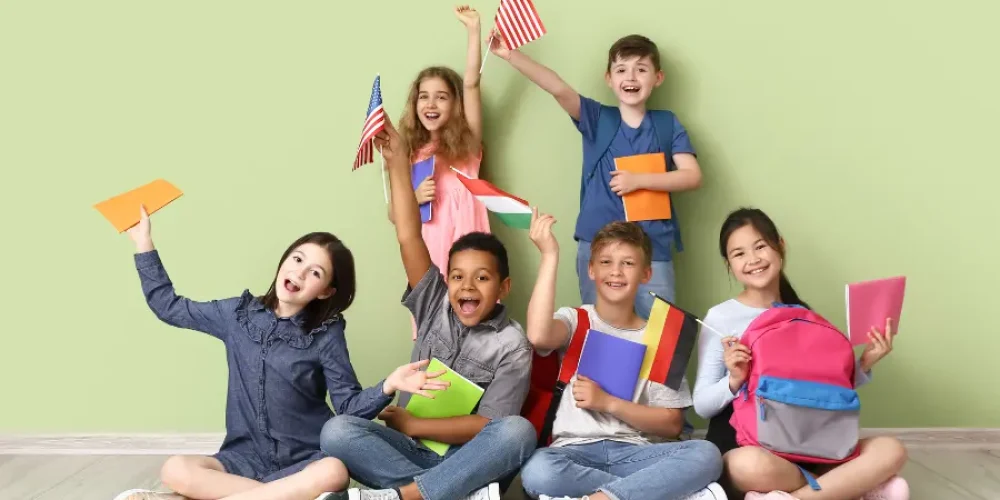
A number of studies have proved the benefit of foreign language training for the development of children's brain functions. From an early age they have a curiosity about everything new and they go with it, including the foreign language. That is why many specialists recommend early foreign language training.
And while children naturally remember language models with various activities in the form of a game, after they are 7 years old, the game model is now combined with suitable ones academic methods.
Specificities of the age group and how they affect the learning process
With the entry of children in school age, significant changes occur in their brain function. They are becoming more and more self-sufficient, and can voluntarily control their behavior. Going to school, they gradually adapt, and every child has a different time for that.
The leading activity is the academic and as children grow older, they develop cognitive perceptions and speech. For them it is easier to remember the study material based on visualization, gradually appearing and more abstract forms of thinking. This applies especially to the initial school age . . The time when children are also acquainted with the written language.
The attention in school age, especially during the 7-11 years, is characterized by instability and easy distractions and this feature is one of the reasons for the lessons to include elements of play and also to change activities often. At this age, they remember verses, facts, develop reasoning abilities. They can analyze phenomena and objects without the need for practical action, which is an indication of the development of their verbal-logical thinking.
At a later stage, students can now provide reasoned evidence that helps them to make logical comparisons and learn more easily from the study material in a native and foreign language.
Integration of school material with language training for better results
The question of when it is best for children to start studying a foreign language has always been a controversy. Some experts recommend starting after 4 years of age, because then words are remembered faster and easier. Others, however, believe that this should happen after 7 years of age when the process is taking place differently. Then children and later teenagers not only memorize but also empathize, understand and structure the text in a foreign language. Another argument is that this is the time when a child already writes in a native language, which benefits the absorption of the foreign one.
In addition, foreign language training of children at school age in no case affects their academic performance and does not divert their focus from the subjects set out in the relevant school program. On the contrary, studies prove that learning a foreign language helps to improve concentration and skills development, related to memory. Multilingual children also achieve greater results in standardized texts, acquire the ability to further understand the vocabulary and structure of their native language.
With the use of balanced trainingincluding the integration of school material with foreign language learning, students can increase their language literacy. The use of individual approach helps to master the structure of the native language and the foreign language. They understand how their native language works, and this also strengthens their ability to read and write.
Students in a language school or center improve their overall results at school because they are able to make faster decisions, think more rationally and switch faster than the native to the foreign language and back into different situations.
It has been proven that it takes about 7 years to learn a child's perfect foreign language. Although there is no precise formula when to start this process, it is still good for the specialists to know the Bulgarian alphabet before the child can read. When it is school age, the larger vocabulary stock, learning the vocabulary and grammar of foreign language improves the absorption of native and enhances metallic consciousness. This leads to better results in both cases.
How to keep interest in learning through a proper balance between serious and fun
A variety of methods are required for the management of a foreign language, especially when it comes to children. For the memory of vocabulary and for the absorption of grammatical and syntaxic structures is used primarily Game Approach as effective enough with appropriate adaptation to any given age.
Experience in learning foreign language for school children shows that they are easier to absorb if given different strategies. They find it difficult to understand the meaning of such a language activity, where they only learn words or rules without purpose or result, even a product. Most of them are more inspired and with greater motivationif during the classes fun elements such as:
- language games;
- audiovisual materials;
- role-playing games;
- organising discussions;
- artistic activities, etc.
For the accumulation of knowledge and the formation of skills to master foreign language helps a combination of traditional and innovative methods. The program, built so that in different aspects to intersect with the school, contributes the skills and habits obtained by students to serve at school as well.
The importance of homework and self-employment at this age
The setting of homework and self-employed work is an essential part of the overall process of language learning. They help students, regardless of their age, to apply what they learn and the teacher . . to get an idea of their achievements and gaps. They can aim to strengthen what they learn, check knowledge and more.
The execution of tasks in the textbook, drawing text, completing a test, making a presentation and more. teach self-discipline and self-discipline which are important qualities for other activities. They can also have individual character depending on the needs of the student.
At Language SchoolOmega It is important for us that children at school age strengthen and upgrade their knowledge of a foreign language acquired in school. Check out the Omegals.bg what opportunities we offer and provide your child or teenager with training of your choice, including preparation for certificate exams and participation in summer programs.