FROM THE OMEGA BLOG

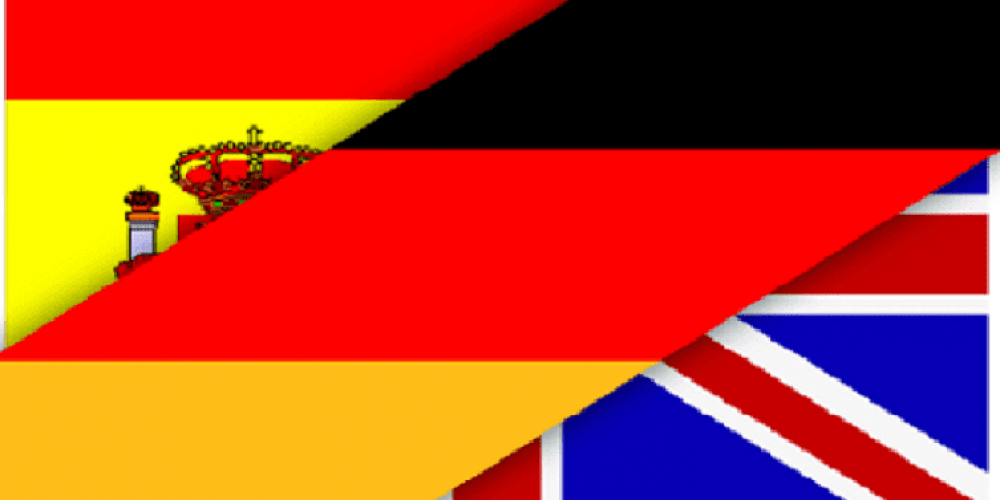
TOP 3 in the most spoken languages in Europe

TOP 3 in the most spoken languages in Europe
Today we often call Europe the Old Continent, but that does not mean that it was created before others. The name simply suggests the importance Europe had in developing today's civilization. The examples are numerous - the Great Geographic discoveries, the Renaissance, the technical revolution and many other geniuses and discoveries that start from here. However, when we list what Europe has given the world, we should not miss one of the most important things - languages. Today we will stop our attention to three of them that are emerging in Europe, but today they have long exceeded the borders of the continent both in terms of distribution and importance.

English

He's the undisputed world favorite. It has long acquired universal status and there is almost no corner of our planet where it is not applicable. Probably almost everywhere in the world he is studied at school as a second language and is necessarily embedded in the curriculum. And this has its practical explanation - it's just the current world language that everyone understands and speaks, more or less. Therefore, English can serve you in any situation when you have to deal with people who do not speak your native language.  Modern English arises around the middle of the 16th century, and its world distribution begins with the rise of Britain as a colonial force. Today it is official in many countries on all continents. the explanation for this is simple - after the end of the colonial era many new countries arise. Their population, however, is diverse - different tribes or nations that have different languages. In order to avoid political and ethnic conflicts in these internal communities, the authorities accept English as an official language.  Today he was born to over 300 million people worldwide, but despite his spread and importance in today's culture, politics and art, he is only third in number to the people who speak it. 

German 

Although there is no popularity in English, do not be fooled that Germans speak only in Germany. It is official in five European countries - Germany, Austria, Switzerland, Luxembourg and Liechtenstein. This means that a significant part of Europe is German-speaking. In this regard, it is about countries with powerful economies that are a factor not only on the Old Continent but also globally. It is not for understatement that over two million German-speaking people live outside the borders of the above mentioned countries, in neighbouring countries - France, Poland, Italy, Belgium, Czech Republic, Hungary, Denmark and Slovakia. And this is not about immigrant communities, but I am about historical condition.  The history of modern German began in the 6th century when the Gorno-Germans separated from other Western German languages. However, his modern appearance will only be acquired in the mid-17th century when he starts to shift Latin as a language of educated people, and as a result, different Gorno-German dialects gradually begin to lose their meaning. It's the language of one of the most influential royal dynasties in Europe. Within the Austrian Empire, for example, it is spreading quite eastly in Europe and at a certain time many of the major cities there - Prague, Budapest, Bratislava and Zagreb are German-pagan. German-language communities are also located further in Eastern Europe. In the mid-20th century, many of them moved to Germany. However, it is a curious fact that today in the number of German-speaking people, Kazakhstan ranks fourth after Germany, Austria, Switzerland and France. 

Spanish

It ranks immediately after the Chinese in numbers of people who speak it in the world. However, unlike China, Spain is a relatively small country. Then where is the secret of the spread of Spanish?  The answer must be looking back in history again in the age of colonization of the New World. Spain is one of the richest countries in Europe at that time, so it is no surprise that it can afford a strong fleet to conquer new lands and expand the empire. In the 16th century, Spanish conquerors introduced language to North and South America, Micronesia, Guam, Mariana Islands, Palau and Philippines. Four centuries later, the same happens in Equatorial Guinea, Western Sahara.  When we talk about the spread of Spanish, it is difficult to list all countries where it is official or very widespread. Today, it is one of the most important world languages because it is spoken on several continents - Europe, North and South America, and parts of Africa and Asia.  Today, many residents of the United States of America, for whom Spanish is not born, are studying it further because of its growing use in business and politics.  If you want to learn one of the most common languages in Europe and the world or improve your level and communication skills, we at Language School . . . . . . . . have wonderful suggestions for you. More about our courses can be found here https://omegals.bg/kursove/za-vyzrastni/ Or by calling us on +359 878 566 537 or 02/423 21 21.
An unexpected error occurred. Reload 🗙