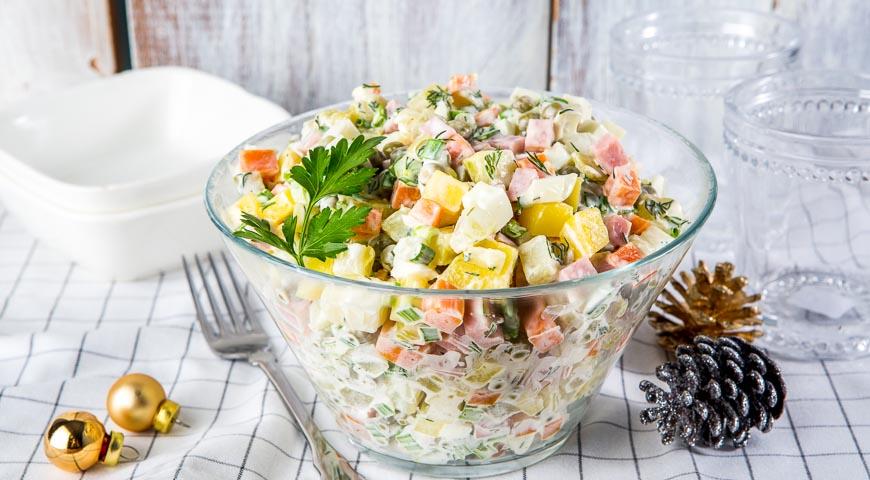
Russian salad
There is no Bulgarian, or at least of those born before 1990, who is not emotionally related to this culinary masterpiece. I still have no explanation for myself where the secret of popularity lies in this not very complicated salad. But let's look at the story. In fact, the notion of Russian salads is probably a unity in Bulgaria. That's understandable because in the way we know her, she comes to us from Russia. Her story is a little different, though. She was born in the Moscow restaurant . . Ermitazh . 1860 by French chef Lucien Olivier. The original recipe includes meat of two pheasants, cooked, a beef tongue, 100 grams caviar, 200 grams lettuce, 25 cancers, 200 grams of small pickles, 200 grams of marinated soybean, 2 fresh cucumbers, 100 grams capers, 5 finely chopped hard boiled eggs. The dressing is a Provensal sauce made of balsamic vinegar, 2 crushed yolk and half a litre olive oil. It is clearly becoming very popular because there are also data on other varieties of it with truffles, fish and smoked duck. It is quite likely, however, that her inventor left any of the ingredients or proportions secret to avoid forgeries. In favour of this theory speaks also the fact that when one of his kitchen assistants stole the recipe, it proved that nevertheless, he never managed to achieve the original taste. In Russia itself, however, this salad is known as In the years, especially in the time of the two world wars, the famous dish suffered many transformations. Many of the products were replaced by more affordable and today salad is made with mayonnaise, cooked potatoes, peas, carrots, pickles, apples, corn and various types of sausages or chicken meat. We have adopted it in this kind of way, and we have put our mark on creativity and called it "Russian."French village cake
And to balance it, we're going to bring the ball back from France to Russia. Yeah, because the recipe for this cake is actually Russian. The story tells that it was invented by a young chef in the courtyard of Queen Elizabeth, the wife of Russian Emperor Alexander I. She did not like the taste of honey, but when she ordered to prepare a new dessert, he made up this honeycake out of ignorance or from courage and ambition to prove himself. After she had tasted it, however, she became her favorite dish and was prepared on all occasions in the palace. Of course, we should mention here that at the heart of this dessert is the unique swamps, which are like honey biscuits in themselves. They are hardly the original invention of the chef in question, but it is a fact that he has garnished them with wonderful cream, fruits and nuts. And the whole combination is still irresistible temptations for every sweetheart.Wine coffee
If you've already eaten the last bite of cake, let's finish the walk with a fragrant Ferris coffee. According to legend, the primordial of this aromatic drink was born in Vienna. However, his author is not a sophisticated barrister who wanted to pamper his clients. The father of the Ferris coffee is Ukrainian Yuri Kulchitzky. In 1660 he fell into captivity of the Turks and over time got to know their culture and language. In 1683 at the siege of the city, he infiltrated the Turkish army and helped the Allied Army release him. For a reward, he only asked for 300 sacks of coffee that soldiers find on an abandoned train. The enterprising Ukrainian advertised the new drink for Europe at that time and opened the first coffee shop in the city. But he realized that the taste of coffee that the Turks so loved was a little distant to local preferences. And to make him more attractive to the viencans, he added sugar and milk. Today, the original drink is made with espresso and served with whipped cream, and sugar is a matter of preference and taste. The fact is, however, that the Vienna coffee in its modern form is different from the original and can be found anywhere in the world. So if you want to enjoy one, you do not necessarily have to go to the capital of Austria. What are the national dishes and how to order them? After debunking some myths, let's also find out what the national dishes are in these countries.Russia
If you get there, do not miss to try the popular Borscht. This soup is actually part of the culinary tradition of many peoples in Eastern and Central Europe. In Russia, however, it is particularly popular and really among the most popular dishes. The recipe includes beets, meat and cabbage. If you want to order, however, keep in mind that they call it a borscht.- Salad present to this day on the New Year's menu in Russia. You can hardly try anything close to the original French chef whose name it bears, but you will touch the taste that the Russians love. Just remember the name correctly, if you forget it, order French salad and they will still serve you the right dish.
- Pickleswhich the locals call Solenya. They can make it from almost all vegetables, even mushrooms, cabbage or apples, but the most popular are cucumbers, tomatoes and peppers. most often consumed as a vodka appetizer, of course.
France
- Onion soup - Typical French specialty. It's made from onions, beef broth, gruer hard cheese and croutons. her ingredients suggest that it was originally a dish for poor people. The secret to its amazing taste, however, lies in the original caramelization of onions. Soupe à l'oignon - is the way it is written in French. Even if you do not know the language, if you try to remember it, you will have one trump card when you look at a sophisticated French menu and order confidently that you will not be mistaken in choosing.
- Ratatouille - typical for Provensal cuisine and is a mixture of eggplants, zucchini, peppers, tomato, onions, garlic and local spices. In French it is known as ratatouille niçoise and means meaning "the Ratatouille of Nice."
- Chocolate souffle - Souffler in French means blow, blow, which describes his technology rather. It deserved to be spent more time with him, but whatever we say, he won't be able to describe this charming, exciting, challenging velvety taste. So just try it!
Austria
- Vienna schnitzel - Wiener Schnitzel, it's not exactly what we here are used to calling by that name. But if you want to try something really Austrian - do not miss to order this delicious piece, highly fucked beef, fried in breadcrumbs and egg. Most often served with a divine potato salad or local pickle.
- Beer - of the traditional Austrian dish, and the beer is also a great match. You will hardly be mistaken for the pronunciation why, although it is written Bier, it is pronounced almost the same as in Bulgarian. A difficulty can be experienced only when choosing a brand. However, our advice is - do not look for familiar tastes, trust local beer and if it is personal production of the restaurant - even better.
Take a look at this: